|
 Functional Materials Group |

|
Research into the Physics of Liquids and Solids
on the Nano- to Meso-Scale
Dr. J.B.W. Webber.

| ||
| ||
|
|
|
Research into the Physics of Liquids and Solids
|
|
Nano-science :We study the structure, dynamics and phases of nano-structured to micro-structured liquids and their solids.
Nano-scale to micro-scale volumetric metrology :The techniques we are developing for nano-scale metrology are based on both physical thermodynamics (Gibbs equations) and on neutron and X-ray scattering. |
We have now been studying the structure, dynamics and phases of nano-structured to micro-structured liquids and their solids for more than 20 years, and are actively unraveling the behaviour of liquids in confined geometry, and at and near surfaces. Even so there is much that we still need to understand about even such basic systems as water in a silica pore.
Some of this basic research has been carried out at the University of Kent, some of the more recent work in conjunction with Heriot Watt University. Lab-Tools are continuing these investigations in conjunction with both universities, both in the Lab-Tools NMR laboratory and at central neutron scattering facilities. This research is of great interest in its own right, but also as needed to support the metrology development. Dr. Beau Webber has also been awarded a total of 88 days of neutron scattering time to aid these studies (23 days as main proposer), at the central facilities at the Institute Laue Langevin in Grenoble (ILL); Laboratoire Leon Brillouin (LLB), Saclay, Paris; at the Jülich Centre for Neutron Science (JCNS), Germany, and ISIS at the Rutherford Lab., to investigate this nano-science and nano-metrology.
Our main experimental techniques are based on:
|

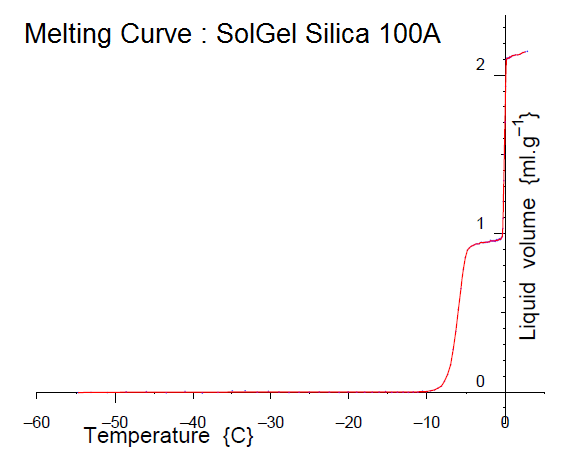
NMR Cryoporometry is a technique for measuring pore size distributions that we originated at Kent and that I have extensively developed.
|
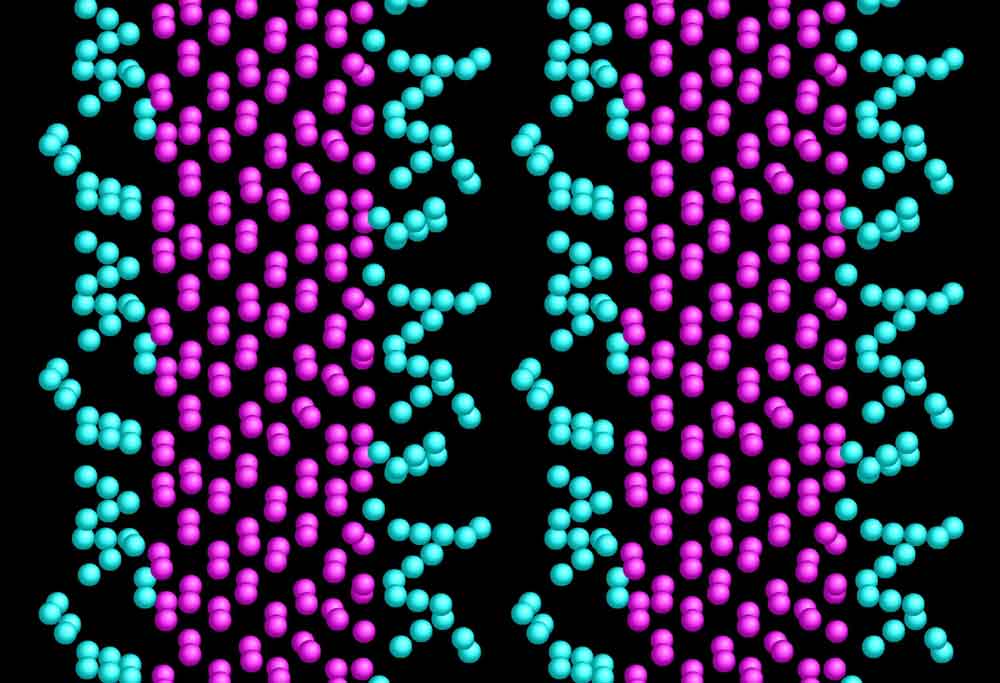
Nano-structured liquidsWhen in pores, water can remain a stable liquid (i.e. in an equilibrium state) more than 20C° below its usual melting temperature - for other liquids the effect can be even larger. Even when ice is formed under these conditions, it can become much more mobile than normal brittle ice, particularly near surfaces.See our invited paper : Structural and Dynamic Studies of Water in Mesoporous Silicas using Neutron Scattering and Nuclear Magnetic Resonance. Beau Webber and John Dore. Invited article, IoP: Journal of Physics: Condensed Matter - Special Issue: Water in Confined Geometry - 16, S5449-S5470, 2004. PII: S0953-8984(04)78970-5 We now partly understand this behaviour in these confined systems, at least on the larger length scales, in terms of the changes in the thermodynamic state - in particular, alterations of the local Gibbs Free Energy. However there are still less-well understood effects, such as the effect of pore geometry on the thermodynamic state. As one approaches the atomic scale there is a need to use tools that take into consideration the atomic nature of the system. We are now beginning to apply ab-initio quantum mechanical molecular dynamic calculations to throw more light on the behaviour of liquids and their solids near surfaces (see figure 1). |
|
|
|
|
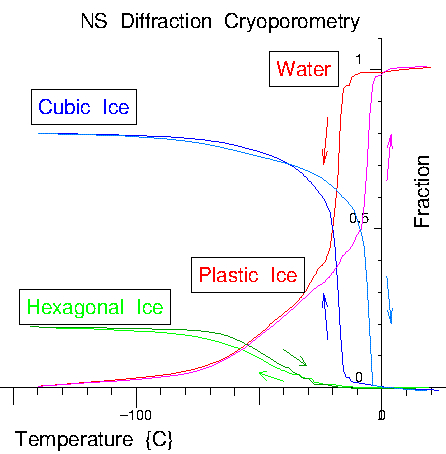
Water/ice systems at interfacesIt is our current belief, from measuring the nano-scale dynamics using NMR relaxation, and the structure from neutron scattering, that there is a layer up to about 1nm thick at ice interfaces where there is considerably enhanced rotational motion, resulting in the continual making and breaking of hydrogen bonds - "plastic ice". This layer also appears to be present at air interfaces, and this may be the reason why glaciers flow - the nano-scale view of the need for plastic terms in the macroscopic viscous-plastic (VP) or elastic-viscous-plastic (EVP) dynamical models of ice and snow-packs in the environment - ( see : Hunke, E. C., Dukowicz, J. K., 1997. An elastic-viscous-plastic model for sea ice dynamics. - Link)Dr. Beau Webber was recently awarded measurement time on the nuetron quasi-elastic scattering spectrometer IRIS at ISIS, to further investigate the dynamics of these thin surface layers.
See some of our papers :
Dynamics at Surfaces : Probing the dynamics of polar and a-polar liquids at silica and vapour surfaces. J. Beau W. Webber, John H. Strange, Philip A. Bland, Ross Anderson and Bahman Tohidi. American Institute of Physics (AIP) Conference Proceedings Series, 1081, 51, 2008. MAGNETIC RESONANCE IN POROUS MEDIA: Proceedings of the 9th International Bologna Conference on Magnetic Resonance in Porous Media (MRPM9). DOI: 10.1063/1.3058545
See my invited review paper :
|
ApplicationsTheses studies are relevant to the following :
|
We have completed many academic research projects and also industrial and commercial analysis projects for high-profile companies using the techniques that we have developed.
Following the above basic research into the behaviour of liquids and their solids in confined geometry, in well characterised porous materials, we then apply this by imbibing these liquids into as yet uncharacterised porous systems, and use the knowledge that we have gained about the changes in their physical properties, when nano-structured, to deduce information about the host porous structure and metrology.
More information on Lab-Tools Ltd. contract nano- to micro-metrology may be found on our nano-metrology page :
www.nano-metrology.co.uk/The basic techniques that use these changes in the thermodynamic properties in nano-structured systems are :
More detailed information about NMR Cryoporometry is available by following the link below to our NMR Cryoporometry pages. |
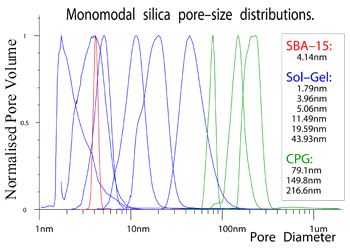
Lab-Tools performs contract analyses of Pore Size Distributions using NMR Cryoporometry :Lab-Tools has measured pore sizes in a wide range of materials, and the technique can be applied to oil and/or water wet materials, and also to materials that can not be dried out without losing their structure.
The Lab-Tools pore-size distribution measurement range extends from about 1nm to nearly 10µm.
Please contact us ( Dr. Beau Webber ) to discuss pore size measurements on your samples. Prices are competitive, but depend on the number of decades of pore-size range to be covered, and precision needed, as these determine the duration of the measurement meeded, which can range from 2 hours to 36 hours.
|
|
With all these thermodynamic techniques, however there is increasingly a
supposition that as atomic dimensions are approached, the
calibration from the thermodynamics may change.
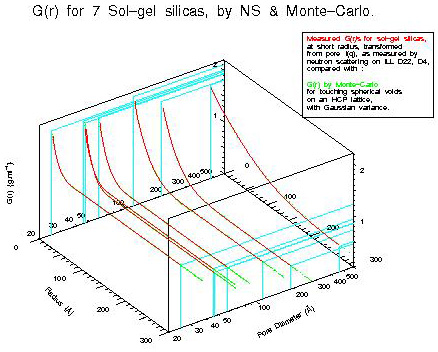
Thus we have mounted a separate metrology program using neutron and X-ray scattering. These have the advantage that they are inverse techniques, by which is meant that the smaller the structure being observed, the larger is the scattering angle. Further, there is no existing reason to suppose that these scattering techniques are length-scale dependent. i.e. if one has a good calibration at one length-scale, it should also be good at all other length-scales. To transform a measured scattering to a metric of the structures in the sample, we create extended models of pore systems, and calculate the scattering using numerical integration. These show very good agreement with measured scattering, figure 3. Our existing measurements using sol-gel silicas have shown that while the thermodynamic techniques are in close agreement with the scattering measurements for dimensions above 10nm, below this dimension there appears to be an increasing divergence between the scales of the thermodynamic and scattering metrologies. Dr. Beau Webber has been awarded measurement time at the Institute Laue Langevin (ILL), on the D4 and D22 instruments, and this has enabled him to develop and verify his models. Dr. Beau Webber was recently awarded measurement time (as first user) on the excellent new wide-scattering range ISIS Target Station 2 instrument NIMROD, and 17 porous samples were measured on this most successful run, with very pleasing preliminary results. Simulation models are being run to match the results, and the models, results and conclusions will be presented in a paper. |
|
|
Cryoporometry pages |

Porous Media pages |